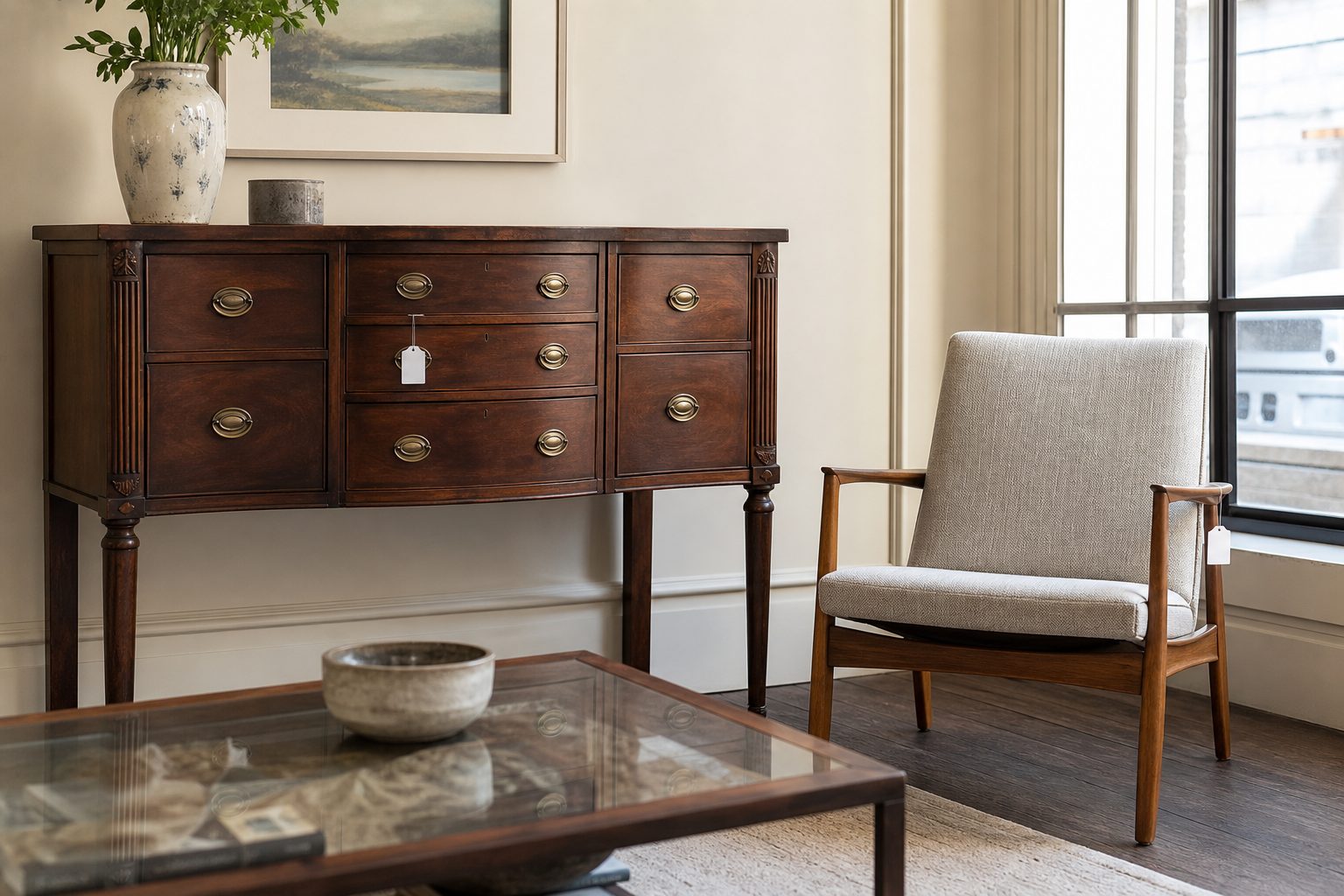
Yes, put it in the sale. Just stop pricing it as furniture and start pricing it as floor space you need to clear before Sunday afternoon. Traditional mahogany and cherry case goods still sell in most US markets. They sell at a small fraction of what the family paid, they sell to people who want a piece rather than a set, and they sell only when the price is low enough that a buyer will borrow a truck for it.
The mistake is not including brown furniture. The mistake is letting a china cabinet at $600 anchor the whole dining room, watching nothing move around it for two days, and then discounting on Sunday when the buyers with trucks have already gone home.
The real work is upstream anyway. It is the conversation you have at the contract table, before anyone has hoped out loud that the dining set will pay for the funeral.
Why traditional dining sets and case goods lost the room
Three forces stacked up, and none of them are reversing on your timeline.
Scale. A 1970s formal dining suite was designed for a dedicated dining room with a nine foot wall for the buffet. Newer construction and most apartment stock does not have that wall. A 72 inch triple dresser physically does not fit where buyers live.
Supply. The generation that bought these suites new is downsizing and dying at the same time. Every week in your market, multiple houses release a dining set, a china cabinet, a bedroom suite and a secretary desk into the same buyer pool. Sustained heavy supply against thin demand sets the price, regardless of build quality.
Use. Formal dining as a household ritual has thinned out. So has the service for twelve, the silver chest and the linen closet full of tablecloths that go with it. Solid dovetailed drawers do not create demand for an object nobody has an occasion to use.
None of that means the wood is worthless. It means the object has moved from the furniture category into the utility category, and utility prices are set by what a functional alternative costs at a big box store on sale.
Keep reading: How do I run the first hour of a sale when eighty people are waiting on the lawn?
Categories still bringing real money out of a house
Walk a house looking for these before you spend an hour arranging the formal living room.
- Sterling silver and gold. Flatware, hollowware, scrap and broken jewelry. This is weight and spot driven, it is fast, and it does not depend on taste.
- Tools and shop equipment. Cast iron table saws, machinists' tool chests, welders, quality hand planes. The garage frequently outperforms the entire first floor.
- Outdoor power and lawn. Working riding mowers, snowblowers, generators, chainsaws. Seasonal demand is sharp and local.
- Firearms and ammunition, handled through the correct licensed channel in your state, never over a folding table.
- Sporting and outdoor. Fly rods, quality bicycles, archery, camping and hunting gear.
- Musical instruments, excluding upright pianos and console organs.
- Textiles. Quilts, oriental rugs in usable condition, vintage clothing that fits current resale demand.
- Coins, currency, stamps, militaria, vintage advertising and signage. Collector categories with active national buyers.
- Kitchenware that people actually cook with. Cast iron, enameled French ovens, stand mixers, restaurant grade pans.
Notice what these have in common. Every one of them is either intrinsically valuable by weight, functionally useful today, or collected by a national buyer pool that will travel or ship. Formal case goods are none of the three.
Midcentury, studio pottery and the demand that stayed
The exception to the furniture story is anything designed between roughly 1945 and 1975 with clean lines, tapered legs and teak or walnut. Those pieces still draw a room. So do good chrome and leather lounge chairs, credenzas of any competent make, and lighting from the same era.
Look for maker's marks and paper labels in drawer bottoms and on the underside of seat rails before you price anything from that period. The difference between an unmarked walnut credenza and a documented one from a known maker is not a modest premium, it is a different price bracket entirely.
Studio pottery holds too. Signed or chopped stoneware, art glass with a recognizable pontil and form, and hand thrown work with a legible mark are worth pulling to a locked case rather than leaving on a shelf. So is mid century Scandinavian glass and anything with a Danish or Finnish maker's sticker still attached.
Practical rule: if it is brown, boxy and carved, it is floor space. If it is brown, low and tapered, slow down and look for a mark.
Keep reading: How do I price a whole house in two days without stalling the entire setup crew?
Pricing large furniture for movement rather than book value
Here is a rule you can apply on Wednesday while you tag.
Start from the honest local resale price for a comparable piece in comparable condition, the price a piece like it actually sells at nearby, not an asking price on a national listing site. Call that the market number. Then apply the reality of your sale window.
- Friday open price: the market number, or slightly under it.
- Saturday: market number less 25 percent, applied across the board on large furniture.
- Sunday morning: market number less 50 percent.
- Sunday final two hours: any reasonable offer, because the alternative is paying somebody to remove it.
Now the arithmetic that settles the argument with the family. Suppose a china cabinet is tagged at $400 and does not sell. Removing it costs you a junk haul share, call it $95 for a piece that size, plus roughly forty minutes of crew time to get it out of the house. So the true value of selling that cabinet for $60 on Sunday is not $60. Measured against the alternative, it is closer to $155 of swing, and it is $155 that shows up on the family's statement instead of a disposal charge.
Work that same subtraction on every oversized piece in the house and your Sunday discounting stops feeling like giving things away.
Freight, stairs and why buyers walk away at the curb
A buyer standing in front of a beautiful $150 breakfront is doing a private calculation you should be doing out loud with them.
- Truck or trailer rental for the afternoon, plus fuel.
- A second person, because nobody moves a breakfront alone.
- Blankets, straps and a dolly.
- Stairs at your house, and stairs at theirs.
- Doorway and stairwell clearance, and whether the piece comes apart.
That easily reaches $100 to $200 of friction before the item is inside their door. When the friction cost approaches the tag price, the buyer walks. This is why furniture prices on the second floor of a house with a turned staircase are structurally lower than the same piece on the ground floor, and why you should tag them lower from the start rather than discovering it on Sunday.
Two things you can do about it. Measure and note whether a piece disassembles, and write that on the tag: a hutch that separates from its base sells to people a one piece hutch cannot. And keep a short list of local movers and haulers who will do a same day pickup for a flat fee, taped to the checkout table. Removing the buyer's logistics problem converts more large furniture than any price cut.
See how EstateTagSale handles this for estate sale companies
Donation, consignment and disposal as planned outcomes
Decide the exit for every large piece before the sale opens, not after it fails to sell. There are only four exits and each has a cost profile.
| Exit | Best for | Cost or return to estate | Timeline |
|---|---|---|---|
| Sale floor | Anything with a plausible local buyer | Net of commission | Sale weekend |
| Consignment or auction | Marked midcentury, signed art, documented pieces | Net of seller premium, often 20 to 40 percent | Weeks to months |
| Donation | Clean, undamaged, upholstery in good shape | Zero cash, possible deduction receipt for the estate | Scheduled pickup, book early |
| Junk haul or dumpster | Damaged, smoke or pet affected, unsellable | Negative, a real line item | Day after the sale |
Book donation pickups before the sale, with a Monday or Tuesday slot. Charities decline stained upholstery, particleboard and anything with structural damage, so walk your list against their acceptance policy rather than assuming they will take what is left.
The expectations conversation before you sign
Do this at the walk through, standing next to the dining set, with the executor present.
Say plainly that the formal furniture will bring a small fraction of its original cost, name a range, and explain why in one sentence about scale, supply and use. Then pivot immediately to where the value actually is in their house, and be specific: the shop, the silver, the rugs, the marked pottery. Families accept the bad news about the sideboard much more easily when it arrives alongside real news about the tool chest.
Get the disposal expectation in writing too. State that unsold large items will be donated or hauled, that hauling is billed at cost, and that they can take any piece back before the haul if they say so by a stated deadline. That one clause prevents the most common post sale dispute in this trade.
Making it legible on the statement
All of this only lands if the family can see it afterward. What each piece was tagged at, what it actually sold for, which day it moved, what was donated, and what removal cost. That is the document that turns a disappointing dining room into a fair outcome the executor can defend to siblings.
EstateTagSale catalogs and prices each item as you tag, runs the markdown schedule across the weekend so your Saturday and Sunday reductions apply cleanly, handles sale day checkout, and settles the whole household into an itemized statement the family can read line by line. Start your next contract in it and let the numbers make the argument for you.